
Written by Emily Satterthwaite
Silent doesn’t always mean passive. My Silence Is Made of Explosions, at the Visu Contemporary Gallery until May 31, explores this. Seven surrealist photographers are brought together in this exhibition to show how acts of seeing can open portals to other realities and freedoms. Through surrealism, the expressions of these women are there for those who know where to look. Silence is not passive, but explosive.

Dora Maar (1907–1997), Portrait of Nusch Eluard, ca. 1935. Vintage gelatin silver print, 24 x 18.4 cm. | © Dora Maar, Collection of David Raymond, North Carolina
My Silence Is Made of Explosions includes the work of both contemporary and pioneer surrealist photographers. By following the movement through time, it’s revealed how unresolved, psychologically charged photographs are still prevalent today. Through the rejection of fixed narratives, the work of these photographers is freed from expectations. Not everything has to be understood.

Dora Maar (1907–1997), Portrait of Nusch Eluard (with foliage), ca. 1935. Vintage gelatin silver print, 12.6 x 18 cm. | © Dora Maar, Collection of David Raymond, North Carolina
One important figure in the foundation of surrealist photography is Dora Maar. Often associated with being the muse and lover of Pablo Picasso, her photomontage and image manipulation innovations were overlooked. It wasn't until the last years of her life that her talent was recognized. This exhibition brings to attention her contributions to surrealism. She becomes freed from her connection to Picasso and stands on her own as an artist – not just a muse.
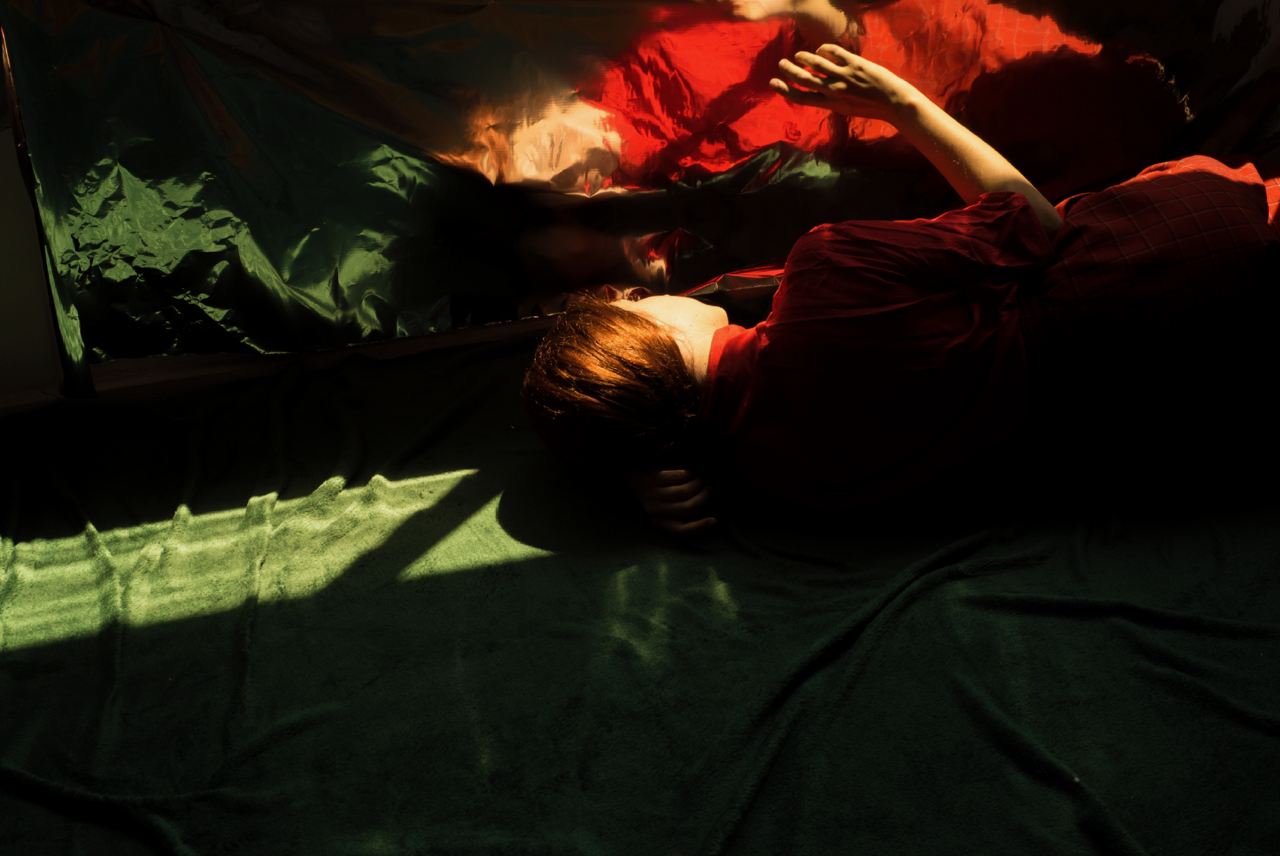
Tania Franco Klein, Positive Disintegration (Self-Portrait), from Positive Disintegration, 2016. Archival pigment print, 28¼ x 42¼ in. | © Tania Franco Klein. Courtesy of the artist and Yancey Richardson, New York
Tania Franco Klein, a contemporary surrealist photographer, often captures the muted aftermath of invisible explosions. Bodies are physically present, but seem psychologically disconnected – faces either turned away from the camera or distorted by a reflective surface. The boundary between fiction and lived experience becomes blurred as these constructed scenes display the silence that is a symptom of modern day alienation. Also focusing on bodies is the work of Elena Dorfman. Her photographs depict the relationship between people and sex dolls. Sometimes lying in bed, other times sitting at a kitchen table, the dolls in these images become eerily real. With men often positioned next to the dolls, interacting with them as if they were human, Dorfman’s work becomes a statement on the absurdity of the male loneliness epidemic.

Elena Dorfman, Ginger Brook 3, 2002. Archival pigment print mounted on aluminum, 30 x 30 in. Edition of 12. | © Elena Dorfman, Courtesy of the artist
Emblematic of the early surrealist exploration of dreams and magic, Patricia Voulgaris uses photography as a medium to amplify details otherwise unseen by the naked eye. Her images appear metaphysical and paranormal. As if snapshots of an alternate world, they invite a contemplation of reality and fantasy.

Elena Dorfman, CJ 3, 2002. Archival pigment print mounted on aluminum, 30 x 30 in. Edition of 12. | © Elena Dorfman, Courtesy of the artist
Women have made significant contributions to the surrealist movement since its formation. These works resist spectacle, instead drawing attention to the slow, often imperceptible build of emotional and psychological intensity. Viewers are invited to engage with silence as a site of complexity, where meaning is not declared, but sensed.

Tania Franco Klein, Body (Self-Portrait), from Positive Disintegration, 2016. Archival pigment print, 27½ x 41⅜ in. Edition 5 of 6 + 2 AP. | © Tania Franco Klein. Courtesy of the artist and Yancey Richardson, New York


